
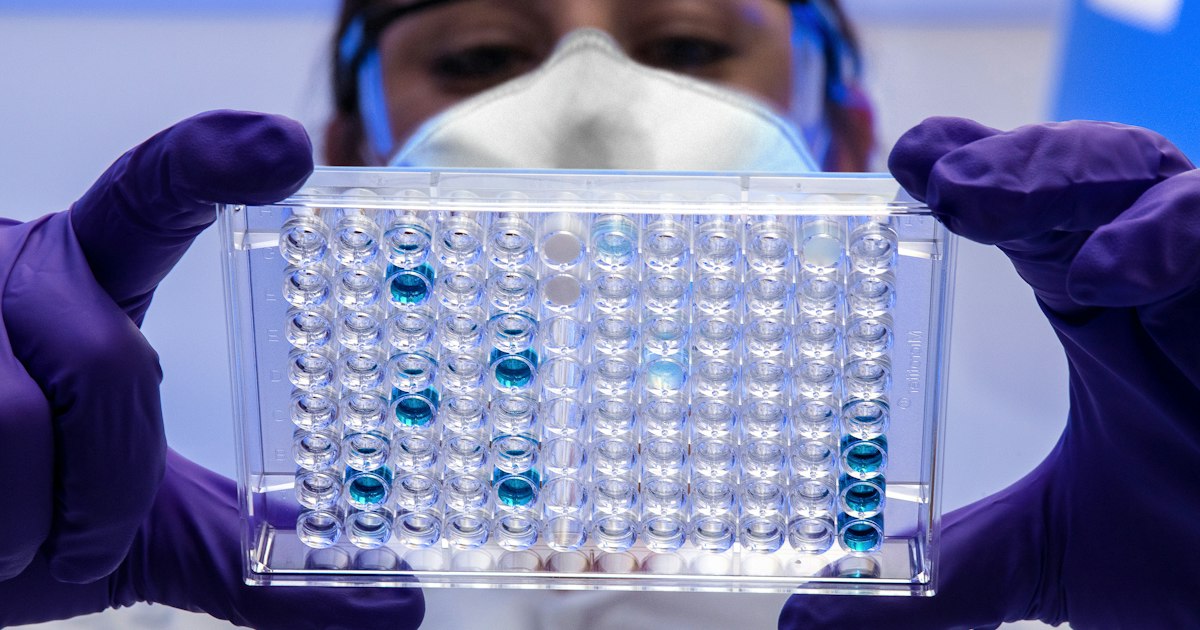
Mechano-growth factor, or MGF, is often billed in the sports community as a "local muscle growth hormone" that kicks in after exercise. Behind this name is a real scientific discovery - and at the same time many simplifications. The editors explain what MGF is from a biological point of view, how it differs from the peptide sold under the same name, and what is actually known about it.
Discovery history
The term "mechano-growth factor" was proposed by the group of the British physiologist Geoffrey Goldspink in the mid-1990s. By studying muscles that were subjected to stretching and electrical stimulation, scientists discovered a messenger RNA variant of insulin-like growth factor 1 (IGF-1), which differed from the known forms and appeared specifically in response to mechanical stress (Yang et al., 1996).
Since this variant was expressed in response to a mechanical stimulus, it was called a mechano-growth factor. The hypothesis was that a muscle, having received damage or stress, first produces a special form of IGF-1, which triggers repair, and only later - a "normal" form that supports growth.
The idea was attractive to sports science because it explained how mechanical work is transformed into a biochemical signal for hypertrophy. In subsequent work, Goldspink's group and other researchers studied MGF in the context of aging, muscular dystrophies, ischemia of the heart and brain.
At the same time, the term "MGF" passed into bodybuilding, where it began to be called a synthetic peptide sold as a separate product. It is important to distinguish these two things from the beginning: the natural isoform of IGF-1 in the body and the synthetic fragment that is offered for injection.
One gene — several proteins: IGF-1 and splicing
The IGF-1 gene in humans consists of six exons — sections that code for the protein. By means of alternative splicing, that is, different "assembly" of exons, several variants of mRNA are formed from one gene. They all encode the same mature IGF-1, but differ in the "tail" - the so-called E-peptide at the C-terminus of the precursor.
| Isoform (human) | Exons of the E region | Features |
|---|---|---|
| IGF-1Ea | 4 + 6 | Basic form; predominates in the liver and muscles |
| IGF-1Eb | 4 + 5 | Minor form in humans |
| IGF-1Ec (MGF) | 4 + part 5 + 6 | Insertion from exon 5 shifts the reading frame; reacts to the load |
In humans, MGF corresponds to the IGF-1Ec isoform. It contains a short insert from exon 5 that changes the reading frame of exon 6 and, accordingly, the sequence of the E-peptide. In rodents, an isoform designated as IGF-1Eb plays a similar role, which is why confusion with names is possible in the literature.
The precursor of IGF-1 (pro-IGF-1) is cleaved after synthesis: mature IGF-1 is separated, and the E-peptide is released separately or remains bound. It is the unique C-terminal part of the Ec-peptide that became the basis for synthetic "MGF".
Therefore, MGF is not a separate hormone with a separate gene, but a product of alternative reading of the IGF-1 gene. Whether its E-peptide has an independent biological function is still a matter of scientific debate.

How MGF supposedly works
According to the Goldspink model, after mechanical stress or muscle damage, the expression of MGF increases rapidly and briefly, and then it is replaced by an increase in the "systemic" form of IGF-1Ea. In the work of Hill and Goldspink (2003) on rodents, this early peak was associated with the activation of satellite cells, the stem cells of the muscle.
In myoblast culture, Yang and Goldspink (2002) reported that a synthetic Ec-peptide stimulated the proliferation of progenitor cells but, unlike mature IGF-1, did not promote their differentiation into fibers. Hence the idea of "two phases": MGF replenishes the pool of cells, and IGF-1 turns them into muscle tissue.
In humans, a study by Hameed et al. (2003) showed that after a single session of intense strength exercise, MGF mRNA expression in muscle of young men increased, whereas the response was markedly weaker in older men. The authors suggested that this may be one of the mechanisms of age-related muscle loss.
The protective effect of Ec-peptide in models of brain and heart ischemia in animals has also been described. However, most of these studies measured mRNA or used a synthetic peptide under laboratory conditions, which does not provide a direct answer to the question of whether exogenous MGF works in humans.
Synthetic MGF and PEG-MGF
What is marketed as “MGF” is a synthetic peptide that reproduces the C-terminal sequence of the Ec domain, often with several amino acid substitutions to increase stability. It is not a full isoform of IGF-1Ec and does not contain mature IGF-1.
Short peptides are quickly destroyed by blood proteases. To prolong the effect, some of the products are modified by pegylation — the addition of polyethylene glycol polymer. Such a product is called PEG-MGF. Pegylation is widely used in pharmaceuticals for registered protein drugs, but for MGF, such modifications have not undergone any regulatory evaluation.
Let's compare the key differences between natural MGF and marketed products:
- Natural MGF is a product of the IGF-1 gene in muscle, produced locally and briefly in response to exercise.
- Synthetic MGF is a short fragment of E-peptide, often with modifications, short time of existence in the blood.
- PEG-MGF is the same fragment with a polymer designed for systemic action, not studied in humans.
There are no controlled clinical trials of synthetic MGF or PEG-MGF in humans evaluating effects on muscle mass, strength, or recovery in the peer-reviewed literature. All information about the "effects" of athletes is based on anecdotal reports.
Controversies, risks and legal status
The MGF concept has scientific critics. In the work of Fornaro et al. (2014), the synthetic MGF peptide did not affect the proliferation or differentiation of mouse and human myoblasts, or primary muscle stem cells. The authors questioned the independent activity of E-peptide.
The review by Matheny, Nindl, and Adamo (2010) also points to the inconsistency of the data: different laboratories have used different peptides, doses, and models, and the presence of free Ec-peptide in human tissues in significant quantities has not yet been conclusively confirmed.
In terms of safety, theoretical risks are related to the fact that MGF is part of the IGF-1 system, and overactivation of this axis is associated with cell proliferation and potentially tumor growth. The risks of uncontrolled products are added: impurities, endotoxins, non-sterility, immune reactions to modified peptides.
The anti-doping status is clear: mechano-growth factors (MGFs) are expressly named in section S2 of the WADA Prohibited List among growth factors and their modulators and are prohibited at all times. As a medicine, MGF is not registered in the USA, the EU, or Ukraine.
Editorial conclusions
MGF is a real scientific concept: this is the name given to the IGF-1Ec isoform, the expression of which increases in muscle in response to mechanical stress. This discovery helped to understand how the muscle responds to training.
Synthetic MGF and PEG-MGF sold for injection are only fragments of the E-peptide, often modified. Their independent activity, even in cell models, is a matter of debate, and there are no data on efficacy in humans.
The products carry uncontrolled quality risks and theoretical risks associated with the IGF-1 system and are prohibited by WADA at any time.
We advise you to continue reading our materials about the mechanism of action of MGF in simple words, about the results of studies of MGF on humans and animals, as well as about IGF-1 and its role in muscle growth.
References
- Yang S, Alnaqeeb M, Simpson H, Goldspink G. Cloning and characterization of an IGF-1 isoform expressed in skeletal muscle subjected to stretch. J Muscle Res Cell Motil. 1996;17(4).
- Yang SY, Goldspink G. Different roles of the IGF-I Ec peptide (MGF) and mature IGF-I in myoblast proliferation and differentiation. FEBS Lett. 2002;522(1–3):156–160.
- Hill M, Goldspink G. Expression and splicing of the insulin-like growth factor gene in rodent muscle is associated with muscle satellite (stem) cell activation following local tissue damage. J Physiol. 2003;549(Pt 2).
- Hameed M, Orrell RW, Cobbold M, et al. Expression of IGF-I splice variants in young and old human skeletal muscle after high resistance exercise. J Physiol. 2003;547(Pt 1):247–254.
- Goldspink G. Mechanical signals, IGF-I gene splicing, and muscle adaptation. Physiology (Bethesda). 2005;20:232–238.
- Matheny RW Jr, Nindl BC, Adamo ML. Minireview: Mechano-growth factor: a putative product of IGF-I gene expression involved in tissue repair and regeneration. Endocrinology. 2010;151(3):865–875.
- Fornaro M, Hinken AC, Needle S, et al. Mechano-growth factor peptide, the COOH terminus of unprocessed insulin-like growth factor 1, has no apparent effect on myoblasts or primary muscle stem cells. Am J Physiol Endocrinol Metab. 2014;306(2):E150–E156.
- World Anti-Doping Agency. The World Anti-Doping Code International Standard: Prohibited List. Montreal: WADA; Ñинна ÑедакÑÑÑ.